Showing posts with label mechanization. Show all posts

Friday, May 31, 2013

Aaannd... we're back.

Finished a very busy semester at school a few weeks ago, and took some time to relax and gather myself. Now, I'm back in the saddle and have a few exciting new projects coming up for the summer, more on those another time.

To make sure I enjoyed myself this summer (and to try to shrink my recently expanded mid-section) I purchased a new bicycle, a fixed gear bike.


I've certainly been critical of fixed gear bikes before, but I have no intention of riding on the street; my main issue with the 'fixie' fad is that these machines are laughably equipped to deal with urban cycling and its many stops and other vehicles. My intent is to take this bike to the exceptional (and lengthy) Bosque Trail here in Albuquerque and compete with myself for the fastest time on the trail. The benefit of a single speed setup is weight reduction, friction reduction and simplicity. I will put a large chainring on the front and focus all my energy on accelerating.
You might remember an interesting photo I put used the Scorchers article of a bicycle-policeman and his enormous chainring.

Arnold Kurth-bicycle police officer

This gave him an advantage in pursuing the speed-obsessed ragamuffins of the day. You can read more about mechanical advantage and gear reduction here.

The biggest chainring I've been able to find is a 54 tooth, installing a new chainring will necessitate a longer chain, and to find the length of the new chain will require... MATH! 
First, we need to know a few things:
A 54 tooth sprocket has a 27 inch circumference (half inch spacing between each tooth)
A 27 inch circumference has an 8.58 diameter (Use Pi)
The rear sprocket has 16 teeth, an 8 inch circumference and a diameter of 2.54 inches
The distance between the crank and the rear bearing in 17.25 inches

You'll have to forgive the crudeness of the sketch
If we look only at the chain we can start to divide it into different, easily calculable sections:
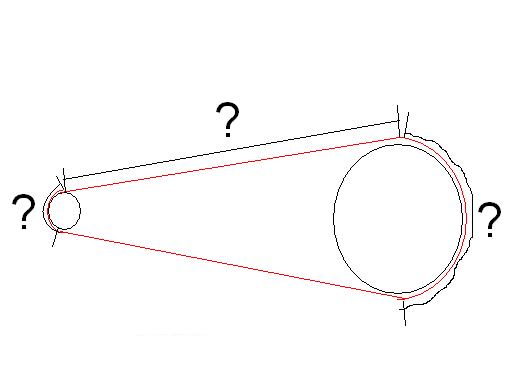
Seriously, drawings not my thing

The sprockets are only covered by chain for about half their circumference, and the chain has two sections running between each sprocket but we only need to calculate this once.
The sprocket measurements are easy, take the circumference and divide it by half. 
Rear = 4 inches of chain
Front = 13.5 inches of chain
To find the connecting length we can use the Pythagorean Theorem, which states that in a triangle with one right angle (90 degrees) the length of the opposite side will be the square root of the sum of each other length squared, or a2 + b2 = c2. To take advantage of this we need to identify a right-angled triangle in the setup, we know that the chain runs from the peak of the rear sprocket to the peak of the chainring (approximately), and this is the length we want to find (c2 or the hypotenuse, in mathematical terms). The bottom side of the triangle can go from the peak of the sprocket to a point inside the area of the chainring, this point is 1.27 inches directly above the center of the chainring. 1.27 is half the diameter of the rear sprocket, or the distance from the center of the sprocket to its peak.
The final side of the triangle is simply half the diameter of the chainring minus half the diameter of the sprocket, 8.58/2= 4.29, 4.29-1.27= 3.02.

Not to scale, duh
Now we can square 17.25 (17.25 x 17.25 = 297.56) and 3.02 (3.02 x 3.02 = 9.12) and add the products together (297.56 + 9.12 = 306.68) and find the square root of the sum (I don't know the notation for square root on this keyboard, but the answer is 17.51). Which means that the total chain length is 4 + 13.5 + 17.51 + 17.51 which equals 52.52 inches of chain. 
Now seems like a good time to mention that there are preprogrammed calculators available to find this for you, I used one to check my work:

But aren't you glad you went through all that?
The calculator got the same answer but was smart enough to round it up for functionality.
 There are a few reasons I chose to do the math myself, first being that I enjoy math and I tend to think about these things even if I don't need the new chain, second that someday I may not have a someone else's knowledge to draw upon, the internet and even books are not guaranteed to us and if someday they aren't around and you need to get something done you'll have to use your brain, and finally because as frustrating and boring as math can be (even I slept through it in school) that doesn't mean it doesn't apply to your life or that you can't find a way to make it fun. 
I'm going to do a few more like this, and I encourage anyone following at home to ask questions or point out where I could have simplified the process. 


Tuesday, March 12, 2013

Salvage Yard II

We visited the scrap yard of Coronado Wrecking and Salvage, here in Albuquerque. They demolish and haul away buildings (or what-have-you) and many of the materials end up in their salvage yard, which is open to the public six days a week. It's a bit hard to find but once you know the way it's quite easy, simply sign in at their office an explore the yard in your vehicle or on foot. I went with some friends and classmates we were looking for steel tubing, chain, sheet metal, and inspiration. We found most of these things, and more. After finding much in the way of useful raw materials, we were able to get down the business of goofing off.

Found these giant sprockets half buried in the sand.

My wannabe artsy photo.

Patrick (from PariahCycle) lending size comparison to a hydraulic ram.


Patrick looking heroic on a luggage tractor.

Joe's new pet chain out for a walk.

Outside of the main office were two antique machines,  believe this to be a printing press.

And this to be some sort of shear.


Salvage Yard

We visited the scrap yard of Coronado Wrecking and Salvage, here in Albuquerque. They demolish and haul away buildings (or what-have-you) and many of the materials end up in their salvage yard, which is open to the public six days a week. It's a bit hard to find but once you know the way it's quite easy, simply sign in at their office an explore the yard in your vehicle or on foot. I went with some friends and classmates we were looking for steel tubing, chain, sheet metal, and inspiration. We found most of these things, and more:

The yard is quite large.


They have some great views.

See much more after the break:

Tuesday, January 8, 2013

Teenage Dream


Making real progress on my motorized bicycle, the Teenage Dream. After riding it happily for a while I became weary of the single speed setup the kit comes with, knowing that there were kits to run the motor through the bikes existing gearing system I decided to make my own setup.
Power comes from the motor to a jackshaft which brings it from the left side to the right (where the transmission is), from there it travels via pulley down do another axle where the chain finally sends power to the back wheel. The pedals have been eliminated, I plan to bump start it until a pull-starter can be worked out.
Fabrication of the lower pulley had already been documented, but making the sprockets and bearing brackets were quite challenging.
Also visible in this photo are the fire extinguisher fuel tank and the ported exhaust pipe, which will soon be modified with a tuned resonance chamber for more power.
It all still looks like a bit of a mess but it will come together into a fun little scoot I believe.

Friday, January 4, 2013

Useless machine?

I enjoy making things, working with my hands, touching my imagination in real life, making disparate objects fit together exactly as I wish. I used to describe my hobbies as anything that 'rolls, explodes or just blows my hair back.' Whenever I think of something it tends to have a purpose, when I come up with ideas that don't do anything I tend to file it away, and only ever think of it again if I can think of a use. As an art student, I frequently debate the practicality of art, and of the things I make. For a long time I would say that "I don't like useless art", by which I meant that if an object didn't serve a utilitarian purpose I didn't like it. Later I amended that to "I don't like things that look like they should do something but don't", and this is still true, if someone builds a full scale motor, but never put any pistons or valves into it, I would call it fairly pointless. There are other points of view, and in that example I can definitely understand the beauty of the motor what it represents.
I suppose the problem is that I feel like the object is only half fulfilling its destiny when it doesn't perform as intended. Cars that sit and are never driven make me sad, especially the gorgeous and powerful ones often collected. A person might say to me that "some things are made to just be beautiful and that's all," and I can't really argue with that. All I can really say is that I'm still disappointed by things which look like they should have a function but can't perform that function.
This machine is a perfect example of nothing I've just written about, while it does not have a utilitarian function it absolutely does something, it performs and interacts:


Something like this, not reliant on its looks but on its actions, ignites a wonderfully whimsical delight in my belly. The device consistently dares the builder to touch a switch, "go ahead, see what happens." It peeks out from its trapdoor just to flip a switch and scampers back as quickly as it can. The whole affair becomes a performance. Watching the builder play with his creation is like watching a puppy chase it tail: yes it's pointless, but it's just so much fun regardless.
Maybe what I've been looking for is not utility, but a way to engage the viewer. The reason I love moving and mechanical objects is how interactive they are, how they require spacial understanding and inspire me to touch and feel the movement. The fine art world tends to be populated by fragile and fearful objects, hiding behind "Do Not Touch" signs like a child born with no immune system; a timid world is not for me. I want a rolling, exploding world, where you grab something and if it doesn't want to be grabbed it punches you in the gut. I want art that tells you "get on the floor and say thanks!" rather than "I don't quite like that, please don't." I think this is a world that needs more personal challenges, and I think art should confront the viewer, not comfort them. "Go ahead, flip my switch, punk."