Showing posts with label education. Show all posts

Sunday, September 15, 2013

One 'art' please...

Golly everyone, it sure is a good thing that I'm in art school, look at this art I made from a picture of my ancient skull:


I found the contrast and brightness sliders all on my own, and I was brave enough to turn them BOTH all the way up. Get ready world, next I'm going to turn your contrast up!

Friday, May 31, 2013

Aaannd... we're back.

Finished a very busy semester at school a few weeks ago, and took some time to relax and gather myself. Now, I'm back in the saddle and have a few exciting new projects coming up for the summer, more on those another time.

To make sure I enjoyed myself this summer (and to try to shrink my recently expanded mid-section) I purchased a new bicycle, a fixed gear bike.


I've certainly been critical of fixed gear bikes before, but I have no intention of riding on the street; my main issue with the 'fixie' fad is that these machines are laughably equipped to deal with urban cycling and its many stops and other vehicles. My intent is to take this bike to the exceptional (and lengthy) Bosque Trail here in Albuquerque and compete with myself for the fastest time on the trail. The benefit of a single speed setup is weight reduction, friction reduction and simplicity. I will put a large chainring on the front and focus all my energy on accelerating.
You might remember an interesting photo I put used the Scorchers article of a bicycle-policeman and his enormous chainring.

Arnold Kurth-bicycle police officer

This gave him an advantage in pursuing the speed-obsessed ragamuffins of the day. You can read more about mechanical advantage and gear reduction here.

The biggest chainring I've been able to find is a 54 tooth, installing a new chainring will necessitate a longer chain, and to find the length of the new chain will require... MATH! 
First, we need to know a few things:
A 54 tooth sprocket has a 27 inch circumference (half inch spacing between each tooth)
A 27 inch circumference has an 8.58 diameter (Use Pi)
The rear sprocket has 16 teeth, an 8 inch circumference and a diameter of 2.54 inches
The distance between the crank and the rear bearing in 17.25 inches

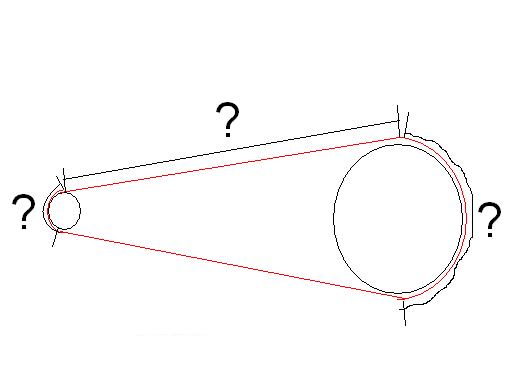
You'll have to forgive the crudeness of the sketch
If we look only at the chain we can start to divide it into different, easily calculable sections:

Seriously, drawings not my thing

The sprockets are only covered by chain for about half their circumference, and the chain has two sections running between each sprocket but we only need to calculate this once.
The sprocket measurements are easy, take the circumference and divide it by half. 
Rear = 4 inches of chain
Front = 13.5 inches of chain
To find the connecting length we can use the Pythagorean Theorem, which states that in a triangle with one right angle (90 degrees) the length of the opposite side will be the square root of the sum of each other length squared, or a2 + b2 = c2. To take advantage of this we need to identify a right-angled triangle in the setup, we know that the chain runs from the peak of the rear sprocket to the peak of the chainring (approximately), and this is the length we want to find (c2 or the hypotenuse, in mathematical terms). The bottom side of the triangle can go from the peak of the sprocket to a point inside the area of the chainring, this point is 1.27 inches directly above the center of the chainring. 1.27 is half the diameter of the rear sprocket, or the distance from the center of the sprocket to its peak.
The final side of the triangle is simply half the diameter of the chainring minus half the diameter of the sprocket, 8.58/2= 4.29, 4.29-1.27= 3.02.

Not to scale, duh
Now we can square 17.25 (17.25 x 17.25 = 297.56) and 3.02 (3.02 x 3.02 = 9.12) and add the products together (297.56 + 9.12 = 306.68) and find the square root of the sum (I don't know the notation for square root on this keyboard, but the answer is 17.51). Which means that the total chain length is 4 + 13.5 + 17.51 + 17.51 which equals 52.52 inches of chain. 
Now seems like a good time to mention that there are preprogrammed calculators available to find this for you, I used one to check my work:

But aren't you glad you went through all that?
The calculator got the same answer but was smart enough to round it up for functionality.
 There are a few reasons I chose to do the math myself, first being that I enjoy math and I tend to think about these things even if I don't need the new chain, second that someday I may not have a someone else's knowledge to draw upon, the internet and even books are not guaranteed to us and if someday they aren't around and you need to get something done you'll have to use your brain, and finally because as frustrating and boring as math can be (even I slept through it in school) that doesn't mean it doesn't apply to your life or that you can't find a way to make it fun. 
I'm going to do a few more like this, and I encourage anyone following at home to ask questions or point out where I could have simplified the process. 


Friday, April 12, 2013

Blacksmithing and Pottery: Two Great Tastes That Blah Blah Blah

I've been watching a lot of blacksmithing and forging videos on YouTube lately, I've been talking about building myself a forge for several years now, and I think the time is approaching. I already have a quantity of kaowool and soft fire-bricks for the insulation, all I need from there is a stand, a burner (propane I think), and an anvil.
During my research I've seen some beautiful and very informative videos, some just plain impressive demonstrations, and some more... eclectic fair. The main thing I've noticed, though, about forging steel, is just how similar to clay it appears to be. Hot steel seems to have a similar 'plastic' stage as clay where it can be worked and shaped, even the ay the materials move under pressure is similar. Just watch the first two-and-a-half minutes of this industry video:


And now watch this woman throw a clay bowl:


Not only does the potter have steel-worker arms but they use basically the same process to manipulate their materials. A quick web search reveals that I'm not nearly the first person to think of this similarity, but it's good to know that I can draw on some of my experience to inform how I work with the iron. Of course there will be discrepancies in the transition: I clearly won't be able to handle the iron in the same way I sculpt clay, no hands or fingers doing the detail work; the iron will need to be at the proper temperature for this to apply; and while clay has the same malleability over its entire volume the iron will only be malleable where hot, which can be a localized area.
All these things important to keep in mind when it comes time to start working, but the main reason I ring this us is that it illustrates the importance of having a broad skill-set. I hadn't ever worked with clay when I first got it in my head to start forging metal, but between then and now that I'm actually about to start I've learned something new which is going to ease my entry into a new craft. I've essentially learned a "craft-and-a-half" in playing with ceramics. So never turn down the opportunity to learn something new, you never know how useful it may be, and even it it isn't, at least you've expanded your mind.

Tuesday, January 22, 2013

Prognostication and one of my prognosticating heroes

With classes back in session, and new job keeping me occupied 30 hours per week, and another potential endeavor into the world of fine art management, posts may become even more erratic and spastic than usual. I hope to keep all my projects documented here for all to enjoy, but they will come in spurts most likely.
Please keep checking back for more fabrication, more fine art, and even more rambling ruminations on my heroes, villains, passions and temporary fixations.
Also, take some time to check in with PariahCycle, a project by a good friend of mine which promises much challenge and even more reward.

But for now, I'd like to tell anyone who may be curious a little about one of my personal heroes, R. Buckminster Fuller (Bucky to his friends). Fuller was something of a renaissance man, he was an inventor, designer, author, and he contributed major thoughts and theories to the early 20th century.


Along with now common words such as synergy, Fuller used the term Dymaxion as a brand name for many of his projects which were designed to improve daily life for humanity and the world in general. His Dymaxion car (below) is an example of one of those projects.


Source

The Dymaxion car was designed based on models tested in a wind-tunnel for aerodynamic efficiency and, along with the Chrysler Airflow (itself a ground-breaking vehicle), was one of the first vehicles in the US to be designed around an aerodynamic form. The Dymaxion could seat 11 passengers, its three wheel, rear-wheel steering allowed it a near zero degree turning radius, it was powered by a 90 horsepower Ford V8 and it reportedly could travel up 120 miles per hour and average 30 miles to the gallon. Keep in mind that in 1930 "the top speed for new cars was 60 mph; fuel efficiency was 25 miles per gallon." 

Unfortunately, during a test drive for the 1933 Worlds Fair, the prototype Dymaxion was involved in a collision with another vehicle, killing its driver and wounding the two passengers. Despite an investigation which revealed the accident was not caused by any design flaw in the Dymaxion but instead by the other vehicle, investors pulled out of funding the project. Some theorize that the accident may have been arranged by large automobile manufacturers of the day, worried that "this revolutionary design would kill all other car sales."

Despite only three Dymaxion cars being built, it had a definite effect on the world around it, inspiring numerous other inventors to try their hand at ultra-modern and efficient vehicles, such as this one:

Source
This is a 1934 patent model for an aerodynamic vehicle designed by Normal Bel Geddes, another designer and industrialist who was most likely influenced by Fuller's Dymaxion car.

Or this one:
Source
The Fascination, another prototype built by the Highway Aircraft Corporation of Sydney, Nebraska. Apparently this one is still a bit of a mystery but at least one was built in the 1970s, with plans for a whole production run.

One can only speculate about the state of the automotive world today if any of these cars had gotten off the ground, and many think the big American auto makers had a strong hand in preventing it. But Mr R.B. Fuller was ahead of the curve and set the standard against which we are only lately trying to compete.

The Dymaxion in action:


Friday, January 4, 2013

Useless machine?

I enjoy making things, working with my hands, touching my imagination in real life, making disparate objects fit together exactly as I wish. I used to describe my hobbies as anything that 'rolls, explodes or just blows my hair back.' Whenever I think of something it tends to have a purpose, when I come up with ideas that don't do anything I tend to file it away, and only ever think of it again if I can think of a use. As an art student, I frequently debate the practicality of art, and of the things I make. For a long time I would say that "I don't like useless art", by which I meant that if an object didn't serve a utilitarian purpose I didn't like it. Later I amended that to "I don't like things that look like they should do something but don't", and this is still true, if someone builds a full scale motor, but never put any pistons or valves into it, I would call it fairly pointless. There are other points of view, and in that example I can definitely understand the beauty of the motor what it represents.
I suppose the problem is that I feel like the object is only half fulfilling its destiny when it doesn't perform as intended. Cars that sit and are never driven make me sad, especially the gorgeous and powerful ones often collected. A person might say to me that "some things are made to just be beautiful and that's all," and I can't really argue with that. All I can really say is that I'm still disappointed by things which look like they should have a function but can't perform that function.
This machine is a perfect example of nothing I've just written about, while it does not have a utilitarian function it absolutely does something, it performs and interacts:


Something like this, not reliant on its looks but on its actions, ignites a wonderfully whimsical delight in my belly. The device consistently dares the builder to touch a switch, "go ahead, see what happens." It peeks out from its trapdoor just to flip a switch and scampers back as quickly as it can. The whole affair becomes a performance. Watching the builder play with his creation is like watching a puppy chase it tail: yes it's pointless, but it's just so much fun regardless.
Maybe what I've been looking for is not utility, but a way to engage the viewer. The reason I love moving and mechanical objects is how interactive they are, how they require spacial understanding and inspire me to touch and feel the movement. The fine art world tends to be populated by fragile and fearful objects, hiding behind "Do Not Touch" signs like a child born with no immune system; a timid world is not for me. I want a rolling, exploding world, where you grab something and if it doesn't want to be grabbed it punches you in the gut. I want art that tells you "get on the floor and say thanks!" rather than "I don't quite like that, please don't." I think this is a world that needs more personal challenges, and I think art should confront the viewer, not comfort them. "Go ahead, flip my switch, punk."

Monday, December 31, 2012

A call for Philosophy in public schools

Michael Shammas: For a Better Society, Teach Philosophy in High Schools
Michael Shammas' call for philosophy as a requirement in lower education is his argument on why he believes philosophy is necessary for a healthy society and a strong republic; "because the capacity to debate requires the capacity to think." He extols philosophy for encouraging students to "entertain a thought without accepting it" and be open to the "possibility that one is wrong."
He wonders why philosophy is not already standard curriculum, supposing that "perhaps the subject seems too esoteric or pretentious" or that "[it] could encroach on the sort of questions religion purports to answer." I think Shammas is missing two key elements of educational history. The first of these is the Educational Progressive movement, which by the 20th century had already branded rote memorization and repetition as ineffective and potentially damaging to students. Great thinkers like John Locke and John Dewey (among many others) claimed that children learned best by observation and personal experience, a pedagogical theory I absolutely agree with. The problem came about when the Progressives finally had the opportunity to explore their theories, once enacted the grand ideas of experiential learning quickly degraded into repetitive worksheets describing situations and asking how students would react to them. The great thinkers of the movement couldn't imbue all the teachers with the ability or resources to truly teach by doing, and they fell back into old habits with repeatable results. Most teachers cannot or will not teach a subject which has no right answers, and requires students to be comfortable with that.
The second piece of history Shammas leaves out is the No Child Left Behind act, which standardized curriculum and (more importantly) testing throughout the country. The reason philosophy can't be taught is the same reason he believes it will help people learn: there are no right answers. A federal standardized testing authority cannot judge whether a student has made a moral, empirically supported argument or a sloppy claim to genius; they have neither the funding nor the objective viewpoint to accomplish this.
This all leaves out the fact that if a student does not want to learn something, they won't. Attempting to introduce students who may already have dismissed education as impractical to their lives to Nietzsche and Kant is unlikely to derail their plans away from school.
None of this means that the subject is unworthy of public education, or that it's simply impossible to implement, but many other pieces need to fall into place before such a proposal could be appreciated.

Wednesday, October 10, 2012

Tomorrows education, today

Jeff Selingo, an editor for The Chronicle of Higher Education recently wrote an article called "College Majors of the Future." In the article he talks about how for non-technical fields majors are not very important, he says "I have found, by talking to employers and educators, that what they want most in their workers is the ability to learn how to learn." He goes on to recommend that students focus more on finding a faculty member they can connect with, undertake a research project, study in foreign countries, and seek out exotic experiences; contending that practices like these lead to more well-rounded and capable workers.

Something Selingo mentions, but does not pay enough attention to, is childhood. He opens the article with "Kids get asked the question from elementary school to high school: “What do you want to be when you grow up?” If they followed through on their answers into adulthood, we would have a complete surfeit of teachers, firefighters, football players, dancers, doctors, and nurses." So while children are questioned about their future careers at an early age, it's only at adulthood that they should start preparing for those careers?

Imagine a world where elementary school students have meaningful relationships with their teachers, are regularly exposed to new ideas and places, junior-high students start to take responsibility for their own learning by researching topics of interest to them, and high school students have the opportunity to see new lands and meet new people as a regular part of their education. How would the world be different with such students entering college or the workforce?

 The highly cited "Future Work Skills of 2020" study says that the next generation of workers will NEED sense-making skills, social intelligence, novel and adaptive thinking, cross-cultural competency and transdisciplinarity in order to compete in the (increasingly) global job market. Those types of skills are literally what can be developed with Selingo's approach summarized above.

 Why skip over the powerful formative years of students and encourage only those who survived the standardized testing to become capable workers? Children and students everywhere need this kind of education NOW.

  College Majors of the Future
  Future Work Skills: 2020