Showing posts with label thoughts. Show all posts

Saturday, February 15, 2014

The Illuminated Tool series

As I near the end of art school I'm expected to take more initiative and to find my "voice." Part of that is  doing an Independent Study, a semester long project of my own design. I'm currently working under Constance Dejong on a series I'm calling Illuminated Tools.
You may be familiar with illuminated manuscripts from the Middle Ages, hand produced books highly decorated with illustration and gold leaf.

Source

I will be applying this methodology to hand tools, items that have come to be considered dirty, low class, and low value. Any good tradesman knows the value of a quality tool, but somehow a country built by tradesmen has allowed the production and sale of cheaply made and disposable tools to take over the market. I suspect this is directly tied to the lack of appreciation given to labor and craft based occupations and the decline of the middle class. But I digress.
My goal is to present high quality, hand made, usable tools that are obviously precious by their polish, adornment and fine materials.
I'll be making four items overall for this project, a hammer, a wrench and a drafting set (a compass and straightedge). These items represent what I believe are the three major stages of human industry that led us to where we are now: forming, such as smithing and hand working raw materials; the industrial revolution, when work became more about operating and maintaining machines than making products; and design, when concept and creation became separated.


I will be making everything but the raw materials by hand for this project, and many of my tools will be homemade as well. I'll also be learning completely new skills like smithing, forge welding, electro-chemical etching, and wood turning. I will also be practicing skills I don't normally use like polishing and drawing. Most of the materials will be forged steel and cast bronze.
This will be my primary project for the next few months.


Sunday, September 15, 2013

One 'art' please...

Golly everyone, it sure is a good thing that I'm in art school, look at this art I made from a picture of my ancient skull:


I found the contrast and brightness sliders all on my own, and I was brave enough to turn them BOTH all the way up. Get ready world, next I'm going to turn your contrast up!

Friday, May 31, 2013

Aaannd... we're back.

Finished a very busy semester at school a few weeks ago, and took some time to relax and gather myself. Now, I'm back in the saddle and have a few exciting new projects coming up for the summer, more on those another time.

To make sure I enjoyed myself this summer (and to try to shrink my recently expanded mid-section) I purchased a new bicycle, a fixed gear bike.


I've certainly been critical of fixed gear bikes before, but I have no intention of riding on the street; my main issue with the 'fixie' fad is that these machines are laughably equipped to deal with urban cycling and its many stops and other vehicles. My intent is to take this bike to the exceptional (and lengthy) Bosque Trail here in Albuquerque and compete with myself for the fastest time on the trail. The benefit of a single speed setup is weight reduction, friction reduction and simplicity. I will put a large chainring on the front and focus all my energy on accelerating.
You might remember an interesting photo I put used the Scorchers article of a bicycle-policeman and his enormous chainring.

Arnold Kurth-bicycle police officer

This gave him an advantage in pursuing the speed-obsessed ragamuffins of the day. You can read more about mechanical advantage and gear reduction here.

The biggest chainring I've been able to find is a 54 tooth, installing a new chainring will necessitate a longer chain, and to find the length of the new chain will require... MATH! 
First, we need to know a few things:
A 54 tooth sprocket has a 27 inch circumference (half inch spacing between each tooth)
A 27 inch circumference has an 8.58 diameter (Use Pi)
The rear sprocket has 16 teeth, an 8 inch circumference and a diameter of 2.54 inches
The distance between the crank and the rear bearing in 17.25 inches

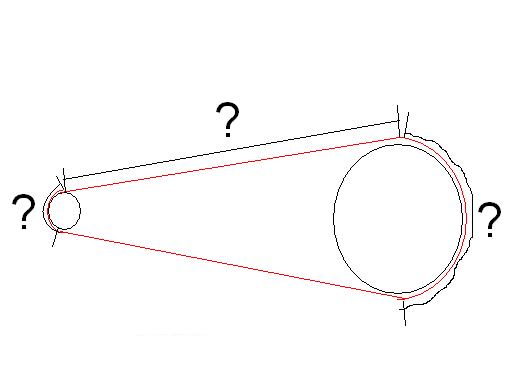
You'll have to forgive the crudeness of the sketch
If we look only at the chain we can start to divide it into different, easily calculable sections:

Seriously, drawings not my thing

The sprockets are only covered by chain for about half their circumference, and the chain has two sections running between each sprocket but we only need to calculate this once.
The sprocket measurements are easy, take the circumference and divide it by half. 
Rear = 4 inches of chain
Front = 13.5 inches of chain
To find the connecting length we can use the Pythagorean Theorem, which states that in a triangle with one right angle (90 degrees) the length of the opposite side will be the square root of the sum of each other length squared, or a2 + b2 = c2. To take advantage of this we need to identify a right-angled triangle in the setup, we know that the chain runs from the peak of the rear sprocket to the peak of the chainring (approximately), and this is the length we want to find (c2 or the hypotenuse, in mathematical terms). The bottom side of the triangle can go from the peak of the sprocket to a point inside the area of the chainring, this point is 1.27 inches directly above the center of the chainring. 1.27 is half the diameter of the rear sprocket, or the distance from the center of the sprocket to its peak.
The final side of the triangle is simply half the diameter of the chainring minus half the diameter of the sprocket, 8.58/2= 4.29, 4.29-1.27= 3.02.

Not to scale, duh
Now we can square 17.25 (17.25 x 17.25 = 297.56) and 3.02 (3.02 x 3.02 = 9.12) and add the products together (297.56 + 9.12 = 306.68) and find the square root of the sum (I don't know the notation for square root on this keyboard, but the answer is 17.51). Which means that the total chain length is 4 + 13.5 + 17.51 + 17.51 which equals 52.52 inches of chain. 
Now seems like a good time to mention that there are preprogrammed calculators available to find this for you, I used one to check my work:

But aren't you glad you went through all that?
The calculator got the same answer but was smart enough to round it up for functionality.
 There are a few reasons I chose to do the math myself, first being that I enjoy math and I tend to think about these things even if I don't need the new chain, second that someday I may not have a someone else's knowledge to draw upon, the internet and even books are not guaranteed to us and if someday they aren't around and you need to get something done you'll have to use your brain, and finally because as frustrating and boring as math can be (even I slept through it in school) that doesn't mean it doesn't apply to your life or that you can't find a way to make it fun. 
I'm going to do a few more like this, and I encourage anyone following at home to ask questions or point out where I could have simplified the process. 


Thursday, April 18, 2013

Lessons and Lacerations

Recently I teased about a new project I was starting, it involved large sheets of glass, approximately 34"x75".


These sheets were very generously donated to me by the Downtown Action Team, a great organization that has helped push out the drug addicts, beggars and fights that accompanied downtown Albuquerque in my youth and replaced it with a business and family friendly environment that I hope will continue to thrive.

This was going to be a minimalist sculpture, consisting of four sheets of glass standing straight up with only a base and no frames.

I hope it's obvious by now why I don't draw.
 Because the sheets are only about an 1/8 of an inch thick I decided that laminating two together would add enough strength to relieve my fears of a stiff breeze bending and breaking the sculpture.
To work with the glass I added extensions onto my workable to support the whole six-foot length.


Knowing that silicone caulking sticks tremendously to glass (both are silica-based after all) I decided that would make a great adhesive for laminating two sheets. But the caulk was WAY too viscous, I couldn't spread it or even get it off my tools our hands until it was cured.


May have ruined this sheet, haven't tried to scrape it off yet but I'm not hopeful.
Not being able to afford a more suitable adhesive in large quantity I decided to risk the project with only one sheet, or possibly use hardware to hold two together.

My original plan involved drilling through one end of the glass sheets so that the angle-steel could be bolted securely on. The plan also involved inserts in the glass holes and rubber washers to keep the hardware from damaging the glass.

Unfortunately, even with a Bosch carbide glass drill bit I didn't even make one hole before the glass broke.


It didn't just break either, it practically EXPLODED, I found shards of glass up to seven feet away from the near-end of the table. Thirty seconds of drilling cost me over three hours of cleanup time, and I'm still finding pieces every day. The dog certainly won't be allowed out there for a long time. While attempting this I had the glass well supported, the drilling area was bathed in water, and I went as slow as my drill could manage.

Changing gears again, I decided that I could put four sheets together in a vertical, rectangular prism with steel frames at top and bottom. Fabrication of the frames went famously, with some of my most precise (non-milled) cuts and best weld beads ever. Unfortunately, I was a little too precise and didn't allow room for the glass sheets to slide past each other during assembly.

I found this out when another sheet exploded in my hands, showering both myself and my partner (who was kind enough to be helping me when she should have been safe and cozy in the house) with tiny shards of glass that were stuck in both our hair and clothes. Thankfully, neither of us were injured.


At this point I decided that the material was too fragile and dangerous for me to continue experimenting with. I still have many sheets left to find another use for, but the minimalist sculpture will have to be achieved in a different way.

This has been a major learning experience for me, I'm used to working with metal, and wood to a lesser extent; materials that can be roughhoused and forced into compliance. If metal or wood needs a hole I drill it, if it needs to be smaller I cut or grind it. Glass is clearly a different kind of animal, it is entirely possible to manipulate it like the others, but the techniques and care needed are much more intensive. I could pay to have professionals do these things for me, but I can't afford that and paying someone else to do it really isn't the point of all this. So, like I  mentioned this glass will be used for something eventually, I just won't have such grand arrogant expectations of making it do my bidding.


Post Script:
By the way, while working with the glass I wore safety glasses the whole time, and while drilling and cleaning up the shards I wore a respirator, some particles were almost microscopic and only visible by a telltale glittering, this is NOT something you want to inhale. Despite my caution with the glass, I spent a lot of time welding in a tank top and was rewarded with a sunburn on one shoulder.


Arc welders like the MIG, TIG and 'stick' produce massive amounts of ultraviolet radiation, the same kind of radiation that comes from the sun and causes burns and cancer,  please be more careful than I was.


Friday, April 12, 2013

Blacksmithing and Pottery: Two Great Tastes That Blah Blah Blah

I've been watching a lot of blacksmithing and forging videos on YouTube lately, I've been talking about building myself a forge for several years now, and I think the time is approaching. I already have a quantity of kaowool and soft fire-bricks for the insulation, all I need from there is a stand, a burner (propane I think), and an anvil.
During my research I've seen some beautiful and very informative videos, some just plain impressive demonstrations, and some more... eclectic fair. The main thing I've noticed, though, about forging steel, is just how similar to clay it appears to be. Hot steel seems to have a similar 'plastic' stage as clay where it can be worked and shaped, even the ay the materials move under pressure is similar. Just watch the first two-and-a-half minutes of this industry video:


And now watch this woman throw a clay bowl:


Not only does the potter have steel-worker arms but they use basically the same process to manipulate their materials. A quick web search reveals that I'm not nearly the first person to think of this similarity, but it's good to know that I can draw on some of my experience to inform how I work with the iron. Of course there will be discrepancies in the transition: I clearly won't be able to handle the iron in the same way I sculpt clay, no hands or fingers doing the detail work; the iron will need to be at the proper temperature for this to apply; and while clay has the same malleability over its entire volume the iron will only be malleable where hot, which can be a localized area.
All these things important to keep in mind when it comes time to start working, but the main reason I ring this us is that it illustrates the importance of having a broad skill-set. I hadn't ever worked with clay when I first got it in my head to start forging metal, but between then and now that I'm actually about to start I've learned something new which is going to ease my entry into a new craft. I've essentially learned a "craft-and-a-half" in playing with ceramics. So never turn down the opportunity to learn something new, you never know how useful it may be, and even it it isn't, at least you've expanded your mind.

Thursday, March 7, 2013

Powerful words

Powerful words spoken by the powerful voice of Charles Bukowski. The images are unnecessary but beautiful regardless. Just close your eyes and think of the grinding procession of time and that tight feeling in your chest when you are overjoyed or terrified.

Friday, February 22, 2013

People who buy things are suckers

Not only is he one of the only good male role models on television, Ron Swanson is  a master craftsman, and he's dead-on right here:


Wednesday, February 20, 2013

The Scorcher Menace

Bicycles are a mainstay on most college campuses, and are becoming increasingly prevalent throughout urban areas. As both a cyclist and a pedestrian I have on more than one occasion been 'buzzed' by a biker, they zoom past from behind with no warning. I have even heard (a small minority of) cyclists complain about pedestrians on sidewalks and brag about riding past them closely. Last year while walking to class I was clipped by a bike and dropped a very fragile and expensive project I was to present that morning. It should come as no surprise that when I encounter a fast cyclist in a crowd I will usually tell them to slow down, get a bell, both, or worse. As it turns out, this isn't a new problem: during the american bicycle boom of the late 19th century, fast bicycle riders called 'scorchers' were considered a public menace, they inspired whole new police divisions to be created just to deal with them and even a medical hysteria, all before spandex or ironic mustaches.


The first bicycle craze happened in the 1860s, when 'boneshakers' briefly gained popularity, though their harsh ride quality drove them out of fashion quickly, to be replaced by the equally uncomfortable 'penny farthing', or 'regular' which had an equally short life in the limelight. When the 'safety bicycle' (what would become the modern, diamond frame bicycle standard) was invented, it revolutionized individual transport.


Boneshaker

We could easily go off topic talking about the ways that the safety bicycle changed the world (lightweight steel tubing, pneumatic tires, gearing systems) and paved the way for automobiles (literally), but today we're discussing the scorcher fad that came with the bicycle boom of the 1890s.

Bicycling had traditionally been the realm of spry young men, mostly due to the extremely difficult riding conditions of the boneshakers and penny-farthings, but when the safety bicycle came to the world many of those conditions disappeared or were lessened considerably. So not only did a wide new range of people take up cycling for fun and commuting, but they could do so at greater speeds than ever thanks to the chain gearing and the bicycle's new, low center of gravity (which made 'taking a header' practically a non-concern). Young men began challenging themselves to reach ever greater speeds.


Cycling was considered a very feminist activity, giving freedom to women everywhere. Though even most feminists advised against wearing men's clothing.
As early as November 1895 citizens were writing in to their local paper complaining that:
"The number of "hoodlums" scorching along... with heads down, with no regard to the safety of persons crossing, is rapidly increasing"
There were cries for police intervention, and arguments that horses would never be allowed to travel so quickly through a crowd. 


Theodore Roosevelt created a “Scorcher Squad” in December 1895, made up of 29 police officers on bicycles. In his autobiography, Roosevelt praised the squad for having “ not only extraordinary proficiency on the wheel, but extraordinary daring.” The Scorcher Squad, in addition to chasing down and ticketing fast bicycle riders, ran down out of control horses and even automobiles, forcing them to slow and eventually stop; some of these events even sound like action-movie fare, such as one officer who made a habit of catching up to runaway horses and getting “alongside the horse and seize the bit in his left hand, keeping his right on the crossbar of the wheel,” at which point he would either dislodge an irresponsible rider or simply calm the horse until it slowed and stopped. These ‘wheel mounted’ police made 1,366 arrests in their first year (though not all of these were bicycle scorchers). Denver, Colorado and Grand Forks, Minnesota began bicycle squads in the summer of 1896, “to control scorchers and sidewalk cyclists.” In Chicago, apparently, bicycle police were using slingshots to hurl lead balls at the spokes of scorchers, the impact would break the rim and bring a cycle to a sudden halt.


Police bicycles had enormous front sprockets to give them an advantage in catching the fastest scorchers.

All the additional attention from the police gave some hope that scorching might soon be eradicated, one New York Times columnist wrote in June, 1896 (under the headline Scorchers WILL Be Suppressed):
"Scorchers are the most dreaded of all evils which terrify the wheeling element. But decided steps have been taken to abate the nuisance, and the consequence will be that shortly the bow-backed fiends will be run to earth and suppressed entirely."
However, two years later scorchers were still considered a menace, and by this time they had automobiles on the road to contend with, “nearly every Sunday the spectacle is presented of reckless wheelmen racing with the cars.”


Many incidences of pedestrians being injured in collisions with cyclists were reported in the last years of the 19th century. In October of 1900 a 55 year old pedestrian died following a collision with a 16 year old scorcher named Harry Morton, who was said to be charged with manslaughter. What became of Morton was not discovered by the time of this writing. 


By the late 1890s, the public had become convinced that not only was scorching dangerous and irresponsible, but that it posed a serious health risk to the riders themselves. The “bicycle heart” was said to come from fast riding, which, according to an army recruiting doctor, had a "tendency to enlarge the heart and thus interfere with its proper action.” The French Army also rejected potential recruits for fast bicycle riding, saying that riders had heart trouble. In July of 1899 the New York Times reported that a fast ride had killed a scorcher, the scorcher also happened to be 64 years old and suffered of heart disease.


The second bicycle boom is considered to have ended by 1903, and the golden age of the scorcher along with it. No single event caused the end of the scorching fad, but the rise in automobile use along with social pressure probably contributed. In The Rise, Fall and Rebirth of Bicycle Police Ross Petty claims that police motorcycles were being used as early as 1908, and that “closed cars became more popular not only for  patrol work, but for pursuing criminals who frequently attempted to escape in cars that could travel at increasingly faster speeds.” So most of the young men and women likely either grew out of the scorching practice or graduated to internal combustion speeding. Bicycles have seen at least two major revivals since then, and more than likely the scorcher has been encountered in each one.


You can peruse my research page for more information, or if you have anything to add please do so.


Tuesday, January 22, 2013

Prognostication and one of my prognosticating heroes

With classes back in session, and new job keeping me occupied 30 hours per week, and another potential endeavor into the world of fine art management, posts may become even more erratic and spastic than usual. I hope to keep all my projects documented here for all to enjoy, but they will come in spurts most likely.
Please keep checking back for more fabrication, more fine art, and even more rambling ruminations on my heroes, villains, passions and temporary fixations.
Also, take some time to check in with PariahCycle, a project by a good friend of mine which promises much challenge and even more reward.

But for now, I'd like to tell anyone who may be curious a little about one of my personal heroes, R. Buckminster Fuller (Bucky to his friends). Fuller was something of a renaissance man, he was an inventor, designer, author, and he contributed major thoughts and theories to the early 20th century.


Along with now common words such as synergy, Fuller used the term Dymaxion as a brand name for many of his projects which were designed to improve daily life for humanity and the world in general. His Dymaxion car (below) is an example of one of those projects.


Source

The Dymaxion car was designed based on models tested in a wind-tunnel for aerodynamic efficiency and, along with the Chrysler Airflow (itself a ground-breaking vehicle), was one of the first vehicles in the US to be designed around an aerodynamic form. The Dymaxion could seat 11 passengers, its three wheel, rear-wheel steering allowed it a near zero degree turning radius, it was powered by a 90 horsepower Ford V8 and it reportedly could travel up 120 miles per hour and average 30 miles to the gallon. Keep in mind that in 1930 "the top speed for new cars was 60 mph; fuel efficiency was 25 miles per gallon." 

Unfortunately, during a test drive for the 1933 Worlds Fair, the prototype Dymaxion was involved in a collision with another vehicle, killing its driver and wounding the two passengers. Despite an investigation which revealed the accident was not caused by any design flaw in the Dymaxion but instead by the other vehicle, investors pulled out of funding the project. Some theorize that the accident may have been arranged by large automobile manufacturers of the day, worried that "this revolutionary design would kill all other car sales."

Despite only three Dymaxion cars being built, it had a definite effect on the world around it, inspiring numerous other inventors to try their hand at ultra-modern and efficient vehicles, such as this one:

Source
This is a 1934 patent model for an aerodynamic vehicle designed by Normal Bel Geddes, another designer and industrialist who was most likely influenced by Fuller's Dymaxion car.

Or this one:
Source
The Fascination, another prototype built by the Highway Aircraft Corporation of Sydney, Nebraska. Apparently this one is still a bit of a mystery but at least one was built in the 1970s, with plans for a whole production run.

One can only speculate about the state of the automotive world today if any of these cars had gotten off the ground, and many think the big American auto makers had a strong hand in preventing it. But Mr R.B. Fuller was ahead of the curve and set the standard against which we are only lately trying to compete.

The Dymaxion in action:


Friday, January 4, 2013

Useless machine?

I enjoy making things, working with my hands, touching my imagination in real life, making disparate objects fit together exactly as I wish. I used to describe my hobbies as anything that 'rolls, explodes or just blows my hair back.' Whenever I think of something it tends to have a purpose, when I come up with ideas that don't do anything I tend to file it away, and only ever think of it again if I can think of a use. As an art student, I frequently debate the practicality of art, and of the things I make. For a long time I would say that "I don't like useless art", by which I meant that if an object didn't serve a utilitarian purpose I didn't like it. Later I amended that to "I don't like things that look like they should do something but don't", and this is still true, if someone builds a full scale motor, but never put any pistons or valves into it, I would call it fairly pointless. There are other points of view, and in that example I can definitely understand the beauty of the motor what it represents.
I suppose the problem is that I feel like the object is only half fulfilling its destiny when it doesn't perform as intended. Cars that sit and are never driven make me sad, especially the gorgeous and powerful ones often collected. A person might say to me that "some things are made to just be beautiful and that's all," and I can't really argue with that. All I can really say is that I'm still disappointed by things which look like they should have a function but can't perform that function.
This machine is a perfect example of nothing I've just written about, while it does not have a utilitarian function it absolutely does something, it performs and interacts:


Something like this, not reliant on its looks but on its actions, ignites a wonderfully whimsical delight in my belly. The device consistently dares the builder to touch a switch, "go ahead, see what happens." It peeks out from its trapdoor just to flip a switch and scampers back as quickly as it can. The whole affair becomes a performance. Watching the builder play with his creation is like watching a puppy chase it tail: yes it's pointless, but it's just so much fun regardless.
Maybe what I've been looking for is not utility, but a way to engage the viewer. The reason I love moving and mechanical objects is how interactive they are, how they require spacial understanding and inspire me to touch and feel the movement. The fine art world tends to be populated by fragile and fearful objects, hiding behind "Do Not Touch" signs like a child born with no immune system; a timid world is not for me. I want a rolling, exploding world, where you grab something and if it doesn't want to be grabbed it punches you in the gut. I want art that tells you "get on the floor and say thanks!" rather than "I don't quite like that, please don't." I think this is a world that needs more personal challenges, and I think art should confront the viewer, not comfort them. "Go ahead, flip my switch, punk."